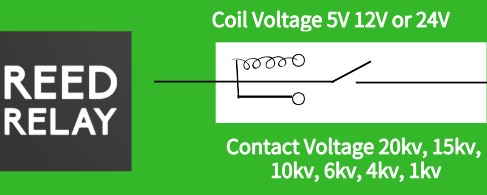
Reed Relays in EV Battery Testing: Application Notes
Introduction: Why Relay Selection Defines Test Accuracy
Electric vehicle battery packs are safety-critical energy storage systems operating at 400V to 800V nominal — and every cell, module, and pack must pass rigorous validation before it reaches a vehicle. Behind every automated test system measuring insulation resistance, open-circuit voltage, or charge/discharge cycling sits a bank of switching relays performing the unglamorous work of routing signals, isolating measurement paths, and protecting instrumentation.
Pick the wrong relay and you introduce thermal EMF drift into your voltage measurements, contact bounce into your data acquisition, or arc flash risk into your high-voltage fixtures. Pick the right EV battery testing relay and your test system delivers repeatable, traceable results across millions of switching cycles.
This application note walks through five real-world EV battery testing scenarios — from high-voltage insulation testing to BMS signal simulation — and maps each one to the specific reed relay technology that solves it best. If you’re building or upgrading battery test equipment, this is the practical guide your relay selection process needs.
Related reading: How to Choose the Right High-Voltage Reed Relay for Your Application
EV Battery Testing Overview
Battery validation spans three structural levels — cell, module, and pack — and each level demands different electrical measurements at different voltage and current ranges:
- Open-Circuit Voltage (OCV) Measurement: Precision voltage reading of individual cells (3.0–4.2V) or series-stacked modules (up to 50V+). Requires microvolt-level accuracy and stable, drift-free switching.
- Internal Resistance (IR) / Impedance Spectroscopy: AC impedance characterization using low-level AC signals superimposed on the cell voltage. Sensitive to contact resistance and contact bounce artifacts.
- Insulation Resistance Testing: Applying a DC bias (typically 500V–2000V) between cell/module terminals and chassis ground, then measuring leakage current. Requires high-voltage switching with high insulation resistance.
- Hi-Pot (Dielectric Withstand) Testing: Applying sustained high voltage (1kV–10kV+) between live conductors and chassis to verify dielectric integrity. Demands the highest voltage ratings.
- Charge/Discharge Cycling: High-current (10A–500A+) cycling of cells and packs to characterize capacity fade, round-trip efficiency, and calendar aging. Requires robust DC contactors.
- BMS Validation: Simulating cell voltages, temperature sensor signals, current transducer outputs, and CAN/SPI communication to verify battery management system firmware and protection logic. Requires dense, fast-switching relay matrices.
The relay matrix is the backbone of any multi-channel battery test system. Whether you’re scanning a 96-cell series string for OCV or switching 5kV insulation test voltage across 12 module-to-chassis isolation paths, your relay choice directly determines measurement integrity.
Why Reed Relays Excel in Battery Testing
Reed relays offer a unique combination of characteristics that make them the preferred switching element in precision battery test equipment:
- Low Thermal EMF: Mercury wetted reed relays generate thermal EMFs below 0.5 µV — an order of magnitude lower than typical electromechanical relays. For OCV measurements where a 10 µV error at the switch translates to a meaningful SOC estimation error, this matters.
- Hermetically Sealed Contacts: The reed switch element is sealed in an inert gas or vacuum environment, eliminating oxidation and contamination that degrade contact resistance over time. This is critical for instruments that must maintain calibration accuracy over years of production testing.
- No Contact Bounce (Mercury Wetted): Mercury wetted reed relays use a mercury film to bridge the contact gap during switching, producing a bounce-free make and break. For impedance spectroscopy and precision voltage measurement, contact bounce introduces high-frequency noise that corrupts the measurement.
- High Insulation Resistance: Reed relays achieve inter-contact insulation resistances exceeding 10¹² Ω (1 TΩ), minimizing leakage current paths that would parallel your measurement and introduce error — especially critical in insulation resistance testing.
- Long Mechanical Life: Reed relays rated at 10⁸ to 10⁹ cycles far outlast electromechanical alternatives, reducing maintenance downtime in 24/7 production test environments.
- Compact Footprint: SIP and DIP packages enable high-density relay matrices on a single PCB, essential for multi-channel cell voltage scanning and BMS signal simulation panels.
- High Voltage Capability: Specialized high-voltage reed relays achieve switching ratings from 3kV to 20kV in a single package, something no comparably sized electromechanical relay can match.
Application 1: High-Voltage Insulation Testing
The Challenge
Insulation resistance testing verifies that the dielectric barrier between live battery conductors and the vehicle chassis meets regulatory requirements (e.g., UN ECE R100 mandates ≥100 Ω/V for DC systems). The test applies a DC bias voltage — typically 500V to 2000V — and measures the resulting leakage current through the insulation.
In a multi-module test fixture, you need to switch this test voltage to different isolation measurement points (module terminal-to-chassis, module terminal-to-module terminal) without introducing parasitic leakage paths through the switch itself.
The Solution: HVR Series High-Voltage Reed Relays
The HVR series provides switching ratings up to 20kV with inter-contact insulation resistance exceeding 10¹² Ω, making it the ideal switching element for automated insulation test fixtures.
Typical Test Setup
- The insulation tester (Megger-type or electronic IR meter) is connected to a common measurement bus.
- An HVR series reed relay per measurement point switches the test voltage between the bus and each module terminal.
- The relay’s high insulation resistance ensures that the leakage path through the switch is negligible compared to the insulation under test.
- A sequencer or test controller commands relays one at a time, with a settling delay (typically 100–500 ms) to allow the insulation measurement to stabilize.
Key design tip: Route high-voltage traces with generous spacing (minimum 6.4mm per kV per IPC-2221) and use guard rings around low-voltage measurement traces to prevent surface leakage from contaminating the reading.
Application 2: Precision Voltage Measurement (OCV / IR)
The Challenge
Open-circuit voltage measurement of individual lithium-ion cells requires microvolt-level accuracy. A typical cell voltage of 3.7V must be measured to ±0.1 mV or better to support state-of-charge (SOC) estimation. Internal resistance measurement — often performed via a pulse test — requires clean switching of both the load path and the voltage sense path, free of contact bounce transients.
Every microvolt of thermal EMF at the relay contact, every milliohm of contact resistance, and every nanosecond of contact bounce directly degrades measurement accuracy.
The Solution: HGFR Series Mercury Wetted Reed Relays
The HGFR series mercury wetted reed relays deliver:
- Thermal EMF below 0.5 µV
- Contact resistance below 100 mΩ (typically 50 mΩ)
- Zero contact bounce — the mercury bridge eliminates the mechanical bounce inherent in dry-reed and electromechanical contacts
- Insulation resistance >10¹² Ω, preventing channel-to-channel leakage in multiplexed configurations
Multiplexing Architecture
For a 96-cell series string, a common architecture uses a 2-pole multiplexing scheme:
- Pole 1 (High): A matrix of HGFR relays connects each cell’s positive terminal to a common “HIGH” sense line.
- Pole 2 (Low): A second matrix connects each cell’s negative terminal to a common “LOW” sense line.
- The differential voltage across the HIGH and LOW lines is measured by a precision DVM (digital voltmeter).
- Two relays per cell (one high, one low) ensure galvanic isolation between measurement paths, preventing sneak current paths through adjacent cells.
The zero-bounce characteristic of mercury wetted relays is essential when the same relays are used for impedance spectroscopy, where fast Fourier transform analysis of the response signal would be corrupted by contact bounce artifacts in the time-domain waveform.
Application 3: BMS Signal Simulation
The Challenge
Battery management system validation requires simulating hundreds of inputs: cell voltages (from DAC outputs), thermistor signals (from programmable resistance decade boxes), current transducer outputs, and digital communication buses (CAN, SPI, I²C). A comprehensive BMS test bench may need to switch 200+ signal channels with fast settling times (<1 ms) and high reliability.
This is a classic BMS test reed relay application — the relay matrix acts as an electronic patch panel, connecting programmable signal sources to the BMS harness.
The Solution: Compact Reed Relay Arrays
Standard SIP-packaged reed relays (such as the GR series) provide an excellent balance of density, speed, and reliability for BMS signal simulation:
- High density: SIP relays placed at 2.54mm pitch allow 40+ relays per 100mm PCB width, enabling 200-channel matrices on a single board.
- Fast switching: Reed relay operate times of 0.5–1.5 ms support rapid channel scanning and signal injection during automated test sequences.
- Long life: 10⁸ cycle ratings ensure the test bench survives years of high-throughput BMS firmware validation.
- Low signal-level performance: Reed relays handle signals from microvolts to 200V without the offset voltages or leakage currents that plague solid-state multiplexers.
Example: Temperature Sensor Simulation
A BMS expects analog voltage from NTC thermistors. The test bench uses a programmable resistance source connected through a reed relay matrix to the BMS temperature input pins. Each relay selects which temperature channel is active, and the resistance source sweeps through the temperature range to verify the BMS’s temperature reporting, over-temperature warnings, and thermal runaway detection logic.
Application 4: Charge/Discharge Cycle Testing
The Challenge
Battery cyclers apply controlled charge and discharge currents (typically 1C to 5C rates) while measuring voltage, current, and temperature over thousands of cycles. For a 100 Ah cell at 1C, that’s 100A continuous through the switch — well beyond the capability of reed relays. The switching element here must handle high DC currents with minimal contact resistance to avoid power loss and self-heating.
The Solution: EVI/EVM Series DC Contactors
For high-current switching in battery cyclers, the EVI and EVM series DC contactors provide:
- Continuous current ratings from 100A to 500A+
- DC voltage ratings compatible with 400V and 800V battery architectures
- Contact resistance below 0.5 mΩ, minimizing I²R losses and self-heating effects that would alter the cell’s thermal state during testing
- Active blowout magnets for arc suppression at DC voltages, extending contact life
Contact Resistance Impact on Measurement Accuracy
At 100A, even 1 mΩ of contact resistance generates 10W of heat at the contact and creates a 100 mV voltage drop — which appears as a measurement error on the cell voltage reading. The EVI/EVM series’ sub-milliohm contact resistance keeps this error below 50 mV, maintaining measurement accuracy within the typical cycler specification.
Design note: Sense the voltage at the cell terminals (4-wire Kelvin connection), not at the contactor output, to eliminate contact resistance from the voltage measurement entirely.
Application 5: Hi-Pot and Dielectric Testing
The Challenge
Hi-pot testing applies a sustained high voltage — often 1.5× to 2× the rated system voltage, or per standards such as IEC 60664 and UL 2580 — between live conductors and chassis ground. For an 800V battery system, test voltages of 2.5 kV to 5 kV DC are typical; for verification testing, voltages may reach 10 kV or higher.
The switching relays in an automated hi-pot test system must reliably switch these voltages without flashover, maintain high insulation resistance between channels, and survive repeated HV switching without contact erosion.
The Solution: HVR Series High-Voltage Reed Relays
Revisiting the HVR series for this demanding application:
- Switching voltage up to 20kV: Covers the full range of hi-pot test requirements for EV battery packs, including rail vehicle and aerospace standards.
- Carry current ratings suitable for the low-current hi-pot measurement path (typically <10 mA).
- Hermetic sealing prevents arc products from contaminating adjacent contacts in a multi-channel fixture.
- Fast operate/release times enable rapid sequencing in high-throughput production test environments.
In a typical automated hi-pot fixture, one HVR relay per test point connects the high-voltage source to the conductor under test, while a second relay connects the chassis ground return path. A safety interlock disables the HV source unless both relays are confirmed closed, preventing unintended energization.
Selection Guide: Choosing the Right Relay for Your Test
The following table maps each test type to the recommended relay series and the critical parameters to evaluate:
| Test Type | Recommended Series | Switching Voltage | Key Parameters | Product Link |
|---|---|---|---|---|
| Insulation Resistance | HVR Series | 500V – 5kV | Insulation resistance >10¹² Ω, leakage current <1 nA | HVR Series |
| OCV / Precision Voltage | HGFR Series | ≤200V | Thermal EMF <0.5 µV, contact resistance <100 mΩ, zero bounce | HGFR Series |
| Impedance Spectroscopy | HGFR Series | ≤200V | Zero bounce, low thermal EMF, fast settling | HGFR Series |
| BMS Signal Simulation | GR Series (SIP) | ≤200V | High density, fast switching (<2 ms), 10⁸ cycle life | Browse Catalog |
| Charge/Discharge Cycling | EVI/EVM Series | ≤1000V DC | Current rating, contact resistance <0.5 mΩ, arc suppression | EVI/EVM Series |
| Hi-Pot / Dielectric Withstand | HVR Series | 2.5kV – 20kV | Dielectric strength, insulation resistance, hermetic sealing | HVR Series |
Design Considerations and Best Practices
PCB Layout for High-Voltage Relays
- Follow IPC-2221 spacing guidelines: minimum 6.4mm clearance per kV of working voltage on external layers.
- Use guard rings (driven traces at the same potential as the measurement node) around high-impedance sense lines to intercept surface leakage currents.
- Route high-voltage traces on external layers with conformal coating or slotting between layers to prevent internal arcing.
- Place relays with consistent orientation to simplify automated optical inspection (AOI) of solder joints.
Shielding and Noise Immunity
- Enclose high-voltage relay matrices in grounded metal enclosures to contain EMI from relay coil switching transients.
- Use twisted-pair wiring for relay coil drive lines to minimize radiated noise coupling into adjacent signal paths.
- Add snubber networks (RC or diode) across relay coil terminals to suppress back-EMF from coil de-energization.
- Separate high-voltage switching sections from low-voltage signal measurement sections on the PCB, ideally on different boards connected via shielded cables.
Thermal Management
- Derate relay current ratings by 50% at ambient temperatures above 40°C. Battery test chambers often reach 45–60°C during thermal cycling.
- For DC contactors in cyclers, monitor contact temperature with thermocouples and reduce test current if contact temperature exceeds 85°C.
- Provide adequate ventilation or forced-air cooling for dense relay matrices where coil power dissipation can raise board temperature.
Derating Guidelines
- Voltage derating: Never operate a relay above 80% of its rated switching voltage for production test applications. For hi-pot testing, select a relay rated at 1.5× your maximum test voltage.
- Current derating: Limit carry current to 75% of the rated maximum for continuous duty. For pulsed applications, verify the relay’s thermal time constant against your pulse profile.
- Cycle count planning: At 10,000 test cycles per day, a 10⁸-cycle relay lasts approximately 27 years. At 100,000 cycles per day (high-throughput BMS simulation), plan for relay replacement every 3 years, or select a 10⁹-cycle rated relay.
Cycle Count and Maintenance Planning
- Log relay cycle counts in the test system software. Trigger maintenance alerts at 50% and 80% of rated life.
- Keep a stock of replacement relays matched by lot and date code for consistent thermal EMF and contact resistance characteristics.
- After relay replacement, perform a calibration check on the affected measurement channels to verify that the new relay’s contact resistance and offset are within tolerance.
Conclusion
Relay selection in EV battery test systems is not an afterthought — it’s a foundational design decision that determines measurement accuracy, system reliability, and regulatory compliance. Whether you need the microvolt-level precision of mercury wetted reed relays for OCV measurement, the 20-kV capability of high-voltage reed relays for insulation and hi-pot testing, or the high-current muscle of DC contactors for charge/discharge cycling, matching the right relay technology to each test requirement is the key to building test systems that deliver trustworthy data.
MiRelay’s complete product portfolio — spanning high-voltage reed relays, mercury wetted reed relays, and DC contactors — is engineered specifically for these demanding applications.
Need help specifying the right relay for your battery test fixture? Contact our engineering team for application support, sample requests, and custom relay solutions.
Related Resources: