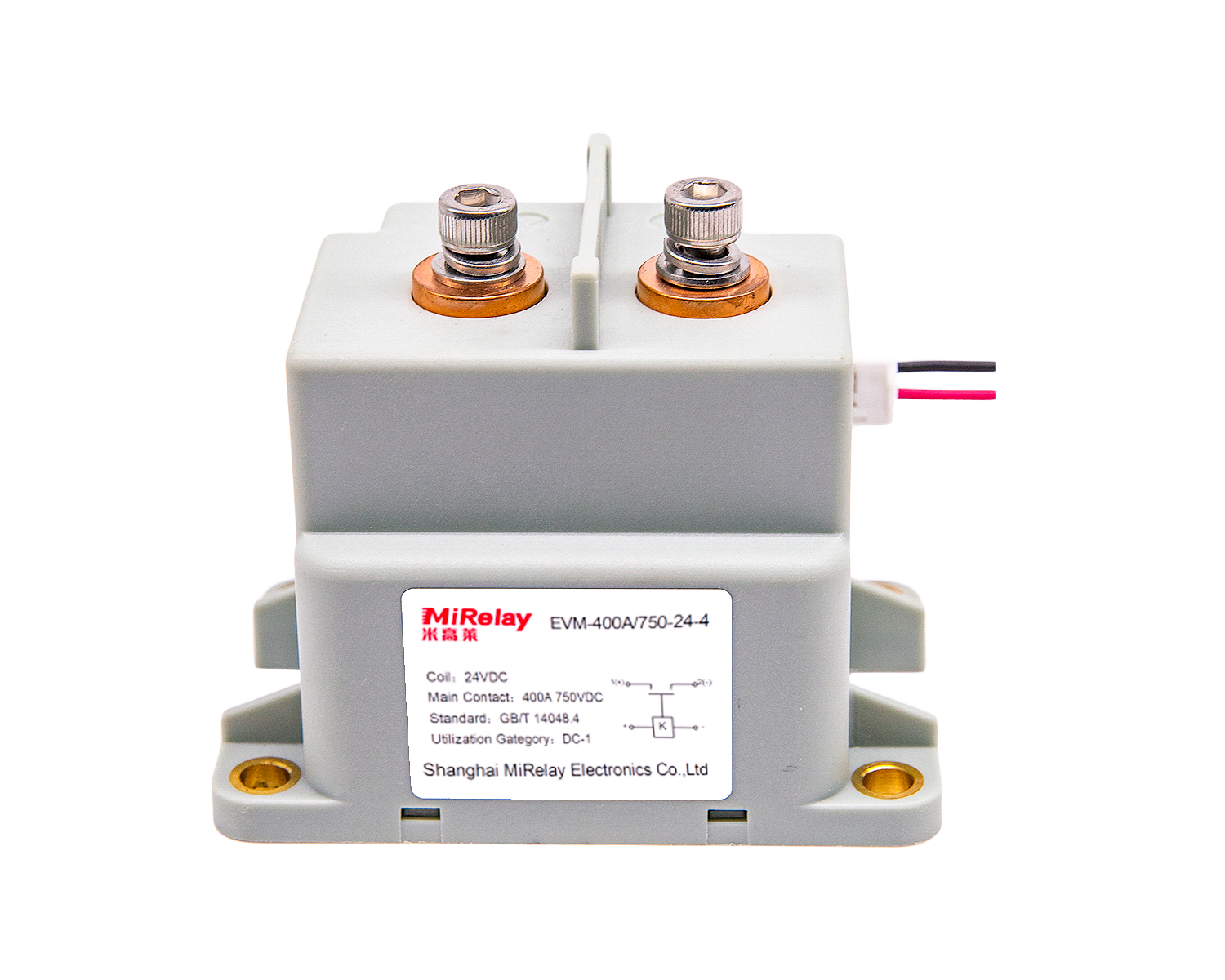
Charging power levels have climbed from 50 kW toward 350 kW, and every step up makes the DC contactor a bigger share of the charger’s safety case. The contactor in a DC fast charger has to carry high continuous current, interrupt fault current safely under load, resist arc erosion over thousands of operations, and hold isolation in an outdoor enclosure. Here is how those requirements map to epoxy and ceramic sealed options.
Ceramic or epoxy
Ceramic-sealed (EVM series) suits high-power applications, 150 kW and up. Ceramic-to-metal sealing provides hermeticity and thermal management that epoxy cannot match:
| Parameter | EVM Series | Epoxy Alternative |
|---|---|---|
| Operating temperature | −40 °C to +85 °C | −25 °C to +70 °C |
| Seal integrity | 10⁻⁹ Pa·m³/s | 10⁻⁶ Pa·m³/s |
| Arc chamber life | 100,000+ operations | 50,000 operations |
| Thermal conductivity | Excellent | Moderate |
Recommended models: EVM-400A/1500V for 350 kW ultra-fast chargers, EVM-250A/1500V for 150–200 kW units.
Epoxy-sealed (EVI series) suits cost-sensitive applications in the 50–150 kW range, with the same proven switching architecture: 450–1500 V ratings, 30–300 A current ratings, and good economics. Recommended models: EVI-200A/1000V for 100–150 kW chargers, EVI-150A/750V for 50–75 kW units.
Selection criteria
Voltage rating
Select a contactor rated at least 20% above maximum system voltage: a 400 V system takes a 500 V+ part, 800 V takes 1000 V+, and 1000 V takes 1200 V+.
Current carrying capacity
Check both continuous and peak current. A practical formula: required rating = max continuous current × 1.25. For a 200 kW charger at 800 V, continuous current is 250 A, so the contactor should be rated 300 A or better.
Breaking capacity
Fault current in a DC system can reach 5–10× rated current, and the contactor has to interrupt it, not just survive it. Magnetic arc blowout is what makes that reliable, and the EVM series arc chamber is the stronger design for high-power duty.
Environment
Outdoor charger cabinets need IP67-class protection at the component level, hermetic sealing for humid and coastal sites, and vibration resistance for high-traffic locations.
Worked example: 150 kW DC fast charger
Specification: 150 kW output, 200–1000 V DC, 200 A maximum continuous current, outdoor installation in an IP65 enclosure.
- Main contactor: EVI-250A/1500V (epoxy, cost-effective)
- Pre-charge contactor: EVI-30A/1000V
- Safety isolation: EVI-100A/1500V on a redundant path
The reasoning: the 1500 V rating gives 50% margin above the maximum system voltage, the 250 A rating carries the continuous load with thermal headroom, and epoxy sealing is adequate inside an IP65 enclosure where the environment is managed.
800 V architectures
The shift to 800 V vehicle platforms (Porsche, Hyundai, Lucid) is pushing demand for 1000 V+ contactors, faster switching for dynamic power management, and compact designs for tight power modules. The EVM-200A/1500V ceramic contactor is built for this class of system: 1500 V isolation for 800 V+ architectures, an 85 × 85 mm footprint, integrated auxiliary contacts for monitoring, and UL and IEC certifications.
In short, EVI epoxy contactors cover most 50–150 kW chargers with good economics, and EVM ceramic contactors are the right call for 150 kW+ and harsh-environment sites. Voltage margin, continuous and fault current, and enclosure conditions decide between them.
For help sizing a charger project, contact [email protected], or see the EVI series and EVM series pages for detailed specifications. The 400V vs 800V vs 1000V selection guide covers the voltage-class comparison in depth.