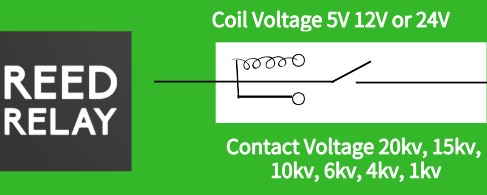
Power Semiconductor Testing: High Voltage Reed Relays for IGBT and SiC Module Validation
Power Semiconductor Testing: High Voltage Reed Relays for IGBT and SiC Module Validation
The global shift toward electric vehicles, renewable energy, and industrial electrification is driving explosive demand for power semiconductors — particularly IGBT modules and SiC (silicon carbide) MOSFETs. These devices operate at voltages from 650V to 3,300V and beyond, switching currents of hundreds of amperes at frequencies up to 100 kHz. Before they reach an EV inverter or a solar inverter, every module must pass rigorous validation testing. And at the heart of every test system sits a component that rarely gets the spotlight: the signal switching relay.
Choosing the wrong relay for a power semiconductor test fixture doesn’t just cause flaky measurements — it can destroy expensive DUTs (devices under test), create safety hazards, and invalidate test data. This post examines why high voltage reed relays have become the standard switching technology in IGBT and SiC test systems, and what engineers should look for when selecting relays for these demanding applications.
The Power Semiconductor Test Challenge
Testing a power module is fundamentally different from testing a low-voltage IC. A typical IGBT or SiC module validation program includes several distinct test categories, each with its own relay requirements:
1. Hi-Pot (High Potential) Testing
Hi-pot testing verifies isolation between the power circuit and the control/signal circuit. Test voltages typically range from 2,500VAC to 5,000VAC (or equivalent DC), applied for 1–60 seconds. The relay switching the hi-pot signal must withstand the full test voltage without breakdown, while maintaining leakage current measurement accuracy in the microampere range.
This is where insulation resistance matters enormously. A relay with 1 GΩ insulation resistance at 5KV produces 5 µA of leakage — potentially exceeding the pass/fail criterion of 1–2 µA for automotive-grade modules. High voltage reed relays with 10+ GΩ insulation resistance keep relay-induced leakage below 0.5 µA, preserving measurement integrity.
2. Isolation Resistance Measurement
Isolation resistance (Riso) measurement applies a DC voltage (typically 500V–1,000V) between isolated circuits and measures the resulting current. For automotive power modules per AEC-Q101, minimum isolation resistance requirements are typically 100 MΩ to 1 GΩ at the rated voltage.
The relay matrix switching these measurements must have insulation resistance significantly higher than the DUT specification. If the relay’s insulation resistance is comparable to the DUT’s, the measurement becomes a parallel resistance calculation rather than a DUT measurement. Reed relays rated at 10+ GΩ provide at least 10× margin over a 1 GΩ DUT requirement.
3. Dynamic Switching Characterization
Dynamic tests measure switching parameters — turn-on time (ton), turn-off time (toff), rise time (tr), fall time (tf), and switching energy (Eon, Eoff). These tests require precise timing measurement with nanosecond resolution, and the signal routing relays must not introduce timing uncertainty.
Contact bounce is the enemy here. An electromechanical relay with 1–5 ms of contact bounce creates transients that can be indistinguishable from actual switching events. Reed relays with 0–50 µs bounce provide clean signal paths that don’t corrupt timing measurements.
4. Gate Drive and Sense Line Switching
Gate drive testing requires switching signals at the gate terminal while simultaneously monitoring collector-emitter voltage and current. Multi-channel relay matrices route gate drive signals, voltage sense lines, and current sense lines to precision instrumentation. The relay must handle the gate drive signal (typically ±15V to ±20V, 0–20A peak drive current) while maintaining isolation from the high-voltage collector circuit.
Why IGBT Testing Pushes Relay Limits
Modern IGBT modules for EV traction inverters operate at 800V DC link voltage with switching speeds of 5–20 kHz. The test system must validate performance under these conditions, which creates specific challenges for signal switching relays:
- dv/dt Immunity: When the IGBT switches at 800V with a dv/dt of 5–15 kV/µs, the fast voltage transient capacitively couples into adjacent signal lines. Relays with poor high-frequency isolation allow this transient to corrupt measurement signals.
- Common-Mode Rejection: The 800V switching creates large common-mode voltages on sense lines. The relay must maintain isolation while the common-mode voltage swings rapidly.
- Thermal Environment: Power semiconductor testing generates significant heat. Test fixtures may operate at 60–85°C ambient, and the relay must maintain specifications across this temperature range.
SiC Testing: An Even Harder Problem
Silicon carbide devices push the envelope further. SiC MOSFETs switch at 50–100 kHz with dv/dt values of 20–50 kV/µs — 2–5× faster than IGBTs. This creates additional challenges:
- Higher EMI: Faster switching generates more electromagnetic interference, which couples into signal routing relays and measurement cables.
- Wider Temperature Range: SiC devices are rated for higher junction temperatures (175°C vs. 150°C for IGBT), and the test environment may be hotter.
- Higher Breakdown Voltage Requirements: SiC modules are available at 1,200V, 1,700V, and 3,300V ratings, requiring test systems to handle higher voltages.
For SiC module testing, the relay selection criteria become even more stringent. The relay must provide clean switching at higher frequencies, maintain isolation under faster transients, and operate reliably in elevated temperature environments.
Reed Relay Advantages in Semiconductor ATE
High voltage reed relays address the unique challenges of power semiconductor testing through several inherent design advantages:
Hermetic Glass Envelope
The sealed glass tube that encloses the reed contacts provides a contamination-free, humidity-independent insulation environment. In a semiconductor ATE system where flux residue, conformal coating outgassing, and ambient humidity vary, this sealed construction ensures consistent insulation performance over millions of operations.
Low and Stable Contact Resistance
Reed relays achieve contact resistances of 50–200 mΩ, stable over their rated lifecycle. For sense line switching in power module testing, this low resistance introduces minimal error in voltage and current measurements. Contact resistance that drifts with cycling — common in EMRs — directly degrades measurement accuracy.
Fast, Bounce-Free Switching
The reed contact’s small mass and short travel distance enable fast closure (50–200 µs) with minimal bounce (0–50 µs). For dynamic switching characterization, this means the relay doesn’t introduce artifacts that could be mistaken for DUT behavior.
Compact Footprint
Power semiconductor test systems often require dense relay matrices — 32, 64, or 128 channels in a compact fixture. Reed relays in DIP or SIP packages provide high channel density without sacrificing voltage rating, enabling more tests per fixture and higher throughput.
MiRelay Product Selection Guide for Power Semiconductor Testing
MiRelay offers several reed relay series optimized for different power semiconductor test applications:
| Test Application | Recommended Series | Key Specifications |
|---|---|---|
| Hi-Pot Testing (2.5–5 KVAC) | HVR Series | 4KV–20KV breakdown, 10+ GΩ insulation, hermetically sealed |
| Isolation Resistance Measurement | HVR Series | Low leakage, high insulation resistance, stable contact resistance |
| Dynamic Switching Characterization | HGFR Series | Zero contact bounce, fast switching, ideal for timing-critical measurements |
| Gate Drive Signal Routing | HGFR / HGSR Series | Low contact resistance, high isolation, bounce-free operation |
| Multi-Channel Relay Matrix | HRM Series | Multi-channel modules, 1–5KV, compact footprint for dense matrices |
Design Considerations for Test Fixture Engineers
Selecting the right relay is only half the battle. The test fixture design must account for the unique characteristics of high-voltage switching in semiconductor ATE:
PCB Layout for High Voltage
At voltages above 1KV, PCB trace spacing becomes critical. IPC-2221 standards specify minimum conductor spacing based on voltage level and pollution degree. For a 5KV test voltage, minimum spacing on an external layer is 12.5 mm (B2 level). Using slot cuts or routed gaps between high-voltage and low-voltage sections provides additional isolation.
Guard Rings and Shields
For precision leakage current measurement, guard rings driven at the same potential as the measurement point eliminate surface leakage currents on the PCB. This is particularly important for hi-pot testing where measurement currents are in the microampere range.
Relay Drive Circuit Design
Reed relays require a specific coil drive current to achieve rated contact performance. Under-driving the coil reduces contact force, increasing contact resistance and potentially causing intermittent connections. Over-driving increases power dissipation and reduces relay life. A well-designed drive circuit maintains constant current regardless of supply voltage variation and temperature.
Thermal Management
While reed relays generate less heat than EMRs, dense relay matrices in high-temperature test environments require attention to thermal design. Ensure adequate airflow over relay arrays and consider the temperature derating curves in the relay datasheet.
Industry Trends: The Growing Demand for Power Semiconductor Testing
The power semiconductor test market is growing rapidly, driven by several converging trends:
- EV Adoption: Every electric vehicle contains 10–20 power modules, each requiring full validation testing. With global EV production projected to reach 40 million units by 2030, the demand for power module test capacity is enormous.
- SiC Transition: The shift from silicon IGBTs to SiC MOSFETs requires new test methodologies and higher-performance test equipment. SiC’s faster switching speeds demand relays with better high-frequency characteristics.
- Renewable Energy: Solar inverters, wind turbine converters, and grid-scale energy storage systems all use power semiconductors that require validation testing.
- Automotive Quality Standards: AEC-Q101 qualification for discrete semiconductors and AQG 324 for power modules require extensive testing, driving demand for high-reliability test infrastructure.
As these trends accelerate, the relay — a seemingly simple component — becomes a critical enabler of test system performance and reliability. Engineers who understand relay selection for power semiconductor testing gain a competitive advantage in building faster, more accurate, and more reliable test systems.
Conclusion
Power semiconductor testing places extreme demands on signal switching relays: high voltage withstand, low leakage, bounce-free operation, and long-term stability. High voltage reed relays meet these demands through hermetic sealing, fixed contact geometry, and proven reliability in semiconductor ATE applications.
Whether you’re building a hi-pot test system for automotive IGBT modules or a dynamic characterization fixture for SiC MOSFETs, relay selection is a design decision that affects measurement accuracy, test throughput, and system reliability. MiRelay’s HVR and HGFR series provide the voltage ratings, insulation performance, and switching characteristics that power semiconductor test engineers demand.
Contact our engineering team to discuss your power semiconductor test application, or browse our high-voltage reed relay catalog for detailed specifications.
Related reading: Mercury Wetted Reed Relays: Why Zero Contact Bounce Matters for ATE Systems | Reed Relays in EV Battery Testing: Application Notes | Testing at 20KV: Selecting High Voltage Reed Relays