How to Choose the Right High Voltage Reed Relay for Your Application
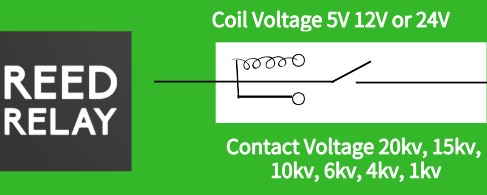
# How to Choose the Right High Voltage Reed Relay for Your Application\n\nWhen designing high-voltage test systems, medical diagnostic equipment, or industrial control circuits, selecting the correct high voltage reed relay is critical to ensuring performance, safety, and long-term reliability.\n\n## Key Specifications to Consider\n\n### 1. Dielectric Strength (Breakdown Voltage)\n\nThe most important specification for any high voltage reed relay is its dielectric strength. This indicates the maximum voltage the relay can withstand without arcing or breakdown.\n\n**Common ranges in our HVR Series:**\n- **4kV – 6kV**: Suitable for low-power testing and basic insulation monitoring\n- **10kV – 12kV**: Most popular for general industrial high voltage testing\n- **15kV – 20kV**: For specialized applications requiring extra high voltage insulation\n\n> **Pro Tip:** Always select a relay with a breakdown voltage rating at least 20% higher than your maximum working voltage. This provides a safety margin for voltage transients and aging.\n\n### 2. Switching Current Rating\n\nHigh voltage reed relays typically handle lower switching currents compared to contactors. Our HVR series offers:\n- **0.5A**: For signal-level measurement and testing\n- **1A**: Most common for general purpose applications\n- **2A**: For higher power switching requirements\n\n### 3. Package Type and Mounting\n\nDifferent applications require different package formats:\n- **Through-hole (TH)**: For traditional PCB assembly, most cost-effective\n- **Surface mount (SMD)**: For high-volume automated assembly\n- **Modular (HRM series)**: For multi-channel high voltage switching systems\n\n### 4. Stand-Off Distance\n\nWhen dealing with high voltages, physical spacing matters. Our relays are designed with proper creepage and clearance distances to prevent surface arcing on PCBs.\n\n## Common Application Recommendations\n\n| Application | Recommended | Dielectric | Current |\n|————-|————-|————|———|\n| BMS Insulation Testing | HVR-XX10 | 10kV | 1A |\n| Medical X-ray Equipment | HVR-XX15 | 15kV | 1A |\n| Multi-channel ATE | HRM Series | 1-5kV per channel | 0.5A |\n| Cable Insulation Testing | HVR-XX20 | 20kV | 0.5A |\n| Capacitor Charging | HVR-XX05 | 5kV | 2A |\n\n## Common Mistakes to Avoid\n\n1. **❌ Underrating the voltage requirement**\n – Always add a safety margin. Arcing at high voltages can destroy your entire circuit.\n\n2. **❌ Ignoring contact resistance requirements**\n – High resistance causes heat and measurement inaccuracy. Our relays guarantee <50mΩ contact resistance.\n\n3. **❌ Forgetting about mechanical life**\n - For high-cycle applications, specify a relay with sufficient mechanical life rating. All our reed relays are rated for >10⁷ operations.\n\n4. **❌ Poor PCB layout**\n – Even with a high-rated relay, poor layout with insufficient copper spacing can cause surface flashover. Follow our layout guidelines in the datasheet.\n\n## Why Choose SHR HVR Series?\n\n- ✅ **15+ years** of high voltage relay manufacturing experience\n- ✅ **Strict quality control** under IATF 16949 certification\n- ✅ **100% electrical testing** of every relay before shipment\n- ✅ **Custom designs** available for unique application requirements\n- ✅ **Competitive pricing** direct from factory\n\n## Need Help Selecting?\n\nIf you’re unsure which model is right for your application, our engineering team is ready to help:\n\n- 📧 Email us your requirements: [[email protected]](mailto:[email protected])\n- 📄 Download our full catalog: [HVR Series Datasheet](https://www.reed-relay.com/wp-content/uploads/datasheets/hvr-series.pdf)\n- 🌐 Learn more about our products: [High Voltage Reed Relays](https://www.reed-relay.com/products/high-voltage-reed-relays/)\n\n—\n\n*Published: March 21, 2026* \n*Category: Technical Guide* \n*Tags: High Voltage Relay, Reed Relay, Selection Guide, Design Tips*\n
Related Resources: