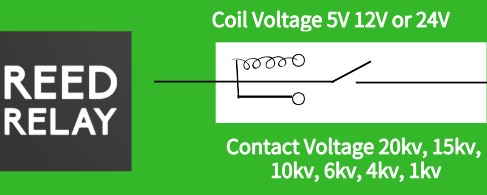
Reed Relays in Semiconductor ATE: Why They Dominate High-Precision Test Systems
Why Semiconductor Test Engineers Keep Choosing Reed Relays
The semiconductor industry moves fast — new process nodes, new chip architectures, new test challenges every quarter. But one component has stubbornly refused to become obsolete: the reed relay. In an era of solid-state multiplexers, RF MEMS switches, and software-defined test architectures, the humble reed relay remains the default switching element inside the most advanced ATE (Automatic Test Equipment) systems on the planet.
That’s not nostalgia. It’s physics. When your test system needs to route a 10 µA precision current source through a switching matrix without introducing thermal EMF errors, or when you need to switch 10 kV hipot voltage across a wafer probe card without flashover, the semiconductor ATE reed relay delivers capabilities that no alternative technology can match at comparable cost and density.
This article examines why reed relays dominate ATE test relay applications, how the technology is evolving to meet 2026’s semiconductor test demands, and what engineers should consider when specifying reed relays for their next test system design.
The Semiconductor ATE Landscape in 2026
Semiconductor test has never been more demanding — or more consequential. The chips being tested today run at higher voltages, faster speeds, and tighter tolerances than ever before:
- AI and HPC chips require testing at extreme power levels (300W+) with thousands of power supply pins, each needing precision voltage and current measurement.
- Automotive ICs demand AEC-Q100 qualification testing across −40°C to +150°C, with zero-defect quality targets that push test coverage requirements to the limit.
- GaN and SiC power devices operate at 1200V–1700V, requiring high-voltage switching in the test fixture that few relay technologies can handle safely.
- Advanced packaging (chiplets, 3D ICs) increases pin counts dramatically, scaling the relay matrix requirements proportionally.
- 5G/6G RF devices need relay matrices with minimal insertion loss and crosstalk at frequencies exceeding 40 GHz.
Behind each of these test challenges sits a matrix of switching relays. And for the analog, power, and high-voltage signal paths in these testers, reed relays remain the technology of choice.
What Makes Reed Relays Ideal for ATE
Zero Thermal EMF
In semiconductor parametric testing, the measurement itself is often a microvolt-level voltage or a nanoamp-level current. Every junction in the signal path generates a thermoelectric EMF (Seebeck effect) that appears as a measurement offset. Mercury wetted reed relays generate thermal EMFs below 0.5 µV — an order of magnitude lower than typical electromechanical relays or solid-state multiplexers with their semiconductor junction potentials.
For a device under test (DUT) with a 1.2V core voltage measured to ±0.1 mV accuracy, a relay-induced 5 µV offset is already 5% of the error budget. In production test environments where measurement accuracy directly impacts yield binning, this matters.
Zero Contact Bounce (Mercury Wetted)
ATE systems measure immediately after relay closure — there’s no settling time budget for contact bounce to decay. Mercury wetted reed relays use a liquid mercury film to bridge the contact gap, producing a completely bounce-free transition. This eliminates:
- False triggering on digital timing channels
- Transient noise in analog measurements
- Corruption of impedance spectroscopy waveforms
- Protocol errors on JTAG, SPI, I²C test buses
Dry reed relays exhibit 10–50 µs of bounce — manageable for power switching but problematic for precision measurements. The choice between mercury wetted and dry reed in ATE is dictated by whether the measurement happens at or near the switching instant.
Hermetic Sealing = Stable Performance
The reed switch element lives inside a sealed glass envelope filled with inert gas (or vacuum). This hermetic seal provides:
- No oxidation — contact resistance remains stable over billions of cycles
- No contamination — flux residue, dust, and outgassing cannot reach the contact surfaces
- Constant insulation environment — dielectric strength doesn’t degrade with ambient humidity or altitude
- Fixed contact geometry — the air gap doesn’t change with mechanical wear because there is no mechanical wear on the contacts themselves
For ATE systems that must maintain calibration accuracy over years of 24/7 production testing, this environmental stability is essential.
High Insulation Resistance
Reed relays routinely achieve inter-contact insulation resistance exceeding 10¹² Ω (1 TΩ). In multiplexed measurement configurations where multiple relays share a common measurement bus, this high insulation prevents channel-to-channel leakage that would parallel the measurement and introduce error.
Consider a 96-channel voltage scanner: if each relay’s insulation resistance is 10 GΩ, the combined leakage from 95 “off” channels totals approximately 9.5 GΩ / 95 = ~100 MΩ effective parallel impedance. For a 1 MΩ input impedance voltmeter, that’s a 1% measurement error from relay leakage alone. Reed relays with 1 TΩ insulation reduce this error to 0.01%.
Long Mechanical Life
ATE relay matrices cycle relentlessly. A production test floor running 50,000 devices per day with 200 switching operations per device executes 10 million relay cycles daily. At that rate:
- A 10⁸-cycle relay lasts 10 days
- A 10⁹-cycle relay lasts 100 days
Reed relays rated at 10⁸ to 10⁹ operations far outlast electromechanical alternatives (typically 10⁵–10⁷ cycles) and eliminate the maintenance burden of frequent relay replacement. For high-volume production test, relay lifecycle directly impacts cost of test.
Compact Form Factor
SIP (Single In-line Package) and DIP (Dual In-line Package) reed relays enable high-density relay matrices on standard PCBs. With pitch spacing as tight as 2.54mm, engineers can pack 40+ relays per 100mm of PCB width — essential for multi-channel semiconductor test configurations where pin counts regularly exceed 1000.
The industry trend toward miniaturization continues: Pickering’s Series 125, which won the Elektra Award 2025, achieves a 5mm × 5mm footprint for a DPST relay — demonstrating that the density race in ATE relay packaging is far from over.
Mercury Wetted vs. Dry Reed: The ATE Decision Matrix
Not every ATE application needs a mercury wetted relay. Understanding when each technology is appropriate saves cost and avoids unnecessary design constraints.
| Application | Mercury Wetted | Dry Reed | Reason |
|---|---|---|---|
| Precision voltage measurement (SMU routing) | ✅ Required | ❌ Avoid | Zero bounce + low thermal EMF essential |
| Impedance spectroscopy | ✅ Required | ❌ Avoid | Bounce corrupts FFT analysis |
| Digital timing channel routing | ✅ Preferred | ⚠️ Acceptable with debounce | Clean edges matter for timing accuracy |
| Power supply routing | ⚠️ Optional | ✅ Preferred | Bounce irrelevant; cost favors dry reed |
| Relay matrix bias/enable lines | ❌ Overkill | ✅ Preferred | Low-speed switching; bounce tolerance high |
| High-voltage switching (>1kV) | ⚠️ Model-dependent | ✅ HVR series | Specialized HV dry reed designs available |
| RF signal routing (>100MHz) | ⚠️ Model-dependent | ⚠️ Model-dependent | Parasitic C and L matter more than bounce |
| Cold environment (<−38°C) | ❌ Mercury freezes | ✅ Required | Mercury solidifies; wetting effect lost |
MiRelay’s ATE-Optimized Product Lines
HGFR Series — Mercury Wetted for Precision
The HGFR series is MiRelay’s flagship ATE relay, designed specifically for high-precision semiconductor test applications. Key specifications:
- Zero contact bounce
- Thermal EMF below 0.5 µV
- Contact resistance below 100 mΩ (typically 50 mΩ)
- Insulation resistance >10¹² Ω
- Switching voltage up to 200V
- 10⁸+ cycle rated life
The HGFR is the standard choice for SMU signal routing, precision voltage scanning, and impedance measurement relay matrices in semiconductor parametric testers.
HRM Series — High-Density Matrix Switching
The HRM series is a modular multi-channel reed relay array designed for high-pin-count semiconductor test. Available in configurations up to 20 channels per module, the HRM reduces PCB area per channel and simplifies wiring in dense test head configurations. The modular approach also enables hot-swappable maintenance in production environments.
HVR Series — High-Voltage Switching
For power semiconductor test (GaN, SiC, IGBT), the HVR series provides switching ratings up to 20 kV. These relays handle the high-voltage stress testing and hipot verification that power device manufacturers require, with insulation resistance >10¹² Ω to maintain measurement integrity at extreme voltages.
Emerging Trends in ATE Relay Technology
Higher Density, Smaller Footprints
The relentless increase in semiconductor pin counts — driven by chiplet architectures, HBM integration, and advanced SoCs — demands relay matrices that scale proportionally. The industry is pushing toward sub-5mm² relay footprints with maintained or improved electrical specifications. MiRelay’s roadmap addresses this with next-generation SIP and LGA-packaged reed relays optimized for automated PCB assembly.
Integration with Smart Relay Drivers
Modern ATE systems are moving toward relay matrices with integrated drive electronics — shift register chains, LED status indicators, and serial bus interfaces that reduce the wiring complexity of large relay arrays. While the reed switch element remains unchanged, the surrounding infrastructure is becoming smarter.
AI-Driven Test Optimization
As AI transforms semiconductor test planning (adaptive test algorithms, predictive yield modeling), the relay matrix benefits indirectly. AI-optimized test programs reduce unnecessary switching, extending relay life and improving throughput. Some advanced test floors are already implementing relay health monitoring — tracking cycle counts and contact resistance trends to predict replacement needs before failures impact production.
Supply Chain Resilience
The 2026 semiconductor supply chain disruptions — driven by geopolitical tensions, helium shortages affecting semiconductor cooling, and material cost inflation — are prompting test equipment OEMs to diversify their relay suppliers. Manufacturers with vertically integrated production (like MiRelay, which controls its reed switch and relay assembly processes) are better positioned to provide supply continuity during disruptions.
Design Considerations for ATE Relay Matrices
PCB Layout for High-Density Relay Boards
- Use ground planes between relay layers to reduce crosstalk in multi-channel configurations.
- Route relay coil drive traces separately from signal paths to prevent switching transient coupling.
- Maintain consistent relay orientation to simplify automated assembly and optical inspection.
- Provide test points for contact resistance measurement during production calibration.
Drive Circuit Best Practices
- Use latching relay drivers where possible to reduce continuous coil power dissipation in dense matrices.
- Implement current-limited drive circuits to prevent coil overdrive — especially important for mercury wetted relays where coil heating accelerates mercury migration.
- Add flyback diodes or snubber networks across relay coils to suppress back-EMF transients that can couple into adjacent signal paths.
Thermal Management in Dense Configurations
- Calculate worst-case power dissipation: each relay coil dissipates 50–200 mW. In a 500-relay matrix, that’s 25–100W total — enough to raise board temperature significantly without adequate cooling.
- For mercury wetted relays, keep ambient temperature below +70°C to prevent mercury migration and contact degradation.
- Consider relay drive sequencing — energize relays sequentially rather than simultaneously to reduce peak current draw and thermal loading.
Cycle Count Planning
At 10 million cycles per day (high-volume production), plan relay replacement schedules based on rated life:
| Rated Life | Days at 10M cycles/day | Replacement Interval |
|---|---|---|
| 10⁸ cycles | 10 days | Weekly (impractical) |
| 10⁹ cycles | 100 days | Quarterly |
| 5 × 10⁹ cycles | 500 days | Annual+ |
For most production ATE environments, 10⁹-cycle relays are the minimum acceptable rating. Higher-rated relays reduce maintenance frequency and cost of test.
The Competitive Landscape: Reed Relay Suppliers for ATE
The ATE reed relay market includes several established players, each with distinct strengths:
| Supplier | Notable Product | Key Strength |
|---|---|---|
| Pickering Electronics | Series 125 (5mm² DPST) | Highest density packaging |
| Coto Technology | 9000 series, CotoMOS | Broad product range, solid-state hybrid options |
| Standex Electronics | High-voltage reed switches | Vertical integration (switch + relay) |
| MiRelay (SHR AUTOSENSOR) | HGFR, HRM, HVR series | Cost-competitive, mercury wetted specialization, fast customization |
| TE Connectivity | V23074 series | Established automotive/industrial channel |
MiRelay differentiates through mercury wetted relay expertise, rapid prototyping capability, and competitive pricing — particularly relevant as major competitors like TE Connectivity implement 5–12% price increases across their product lines in 2026.
Getting Started
Whether you’re designing a new semiconductor parametric tester, upgrading a legacy ATE relay matrix, or troubleshooting bounce-related measurement issues in an existing system, selecting the right reed relay technology is a foundational design decision.
MiRelay’s applications engineering team can help you:
- Select the optimal relay series (HGFR for precision, HRM for density, HVR for high voltage)
- Design relay drive circuits appropriate for your test system architecture
- Specify relay matrices that balance performance, density, and cost
- Provide samples for evaluation in your specific application
Contact our engineering team to discuss your semiconductor ATE relay requirements, request datasheets, or get application-specific design guidance.