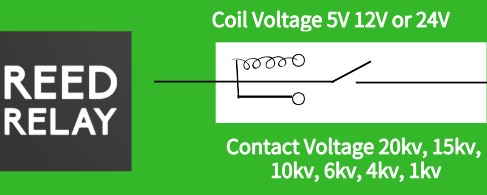
Reed Relay Principles
How a Reed Relay Works
A reed relay consists of a reed switch enclosed within a coil. The reed switch itself is composed of two ferromagnetic blades (reeds) hermetically sealed in a glass envelope. The envelope is filled with an inert gas, typically Nitrogen, to prevent oxidation.
[Image of reed relay internal structure]Magnetic Actuation
When current flows through the coil, it generates a magnetic field. This field permeates the ferromagnetic reeds, causing them to attract each other. When the magnetic force exceeds the mechanical spring force of the reeds, the contacts close, completing the circuit.
Advantages over Electromechanical Relays
- Hermetic Seal: Immune to dust, moisture, and corrosion.
- Speed: Switching times as fast as 0.5ms (10x faster than EMRs).
- Life: Up to billions of operations for low-level loads.
SIP Series
Standard Reed Relays for general switching.