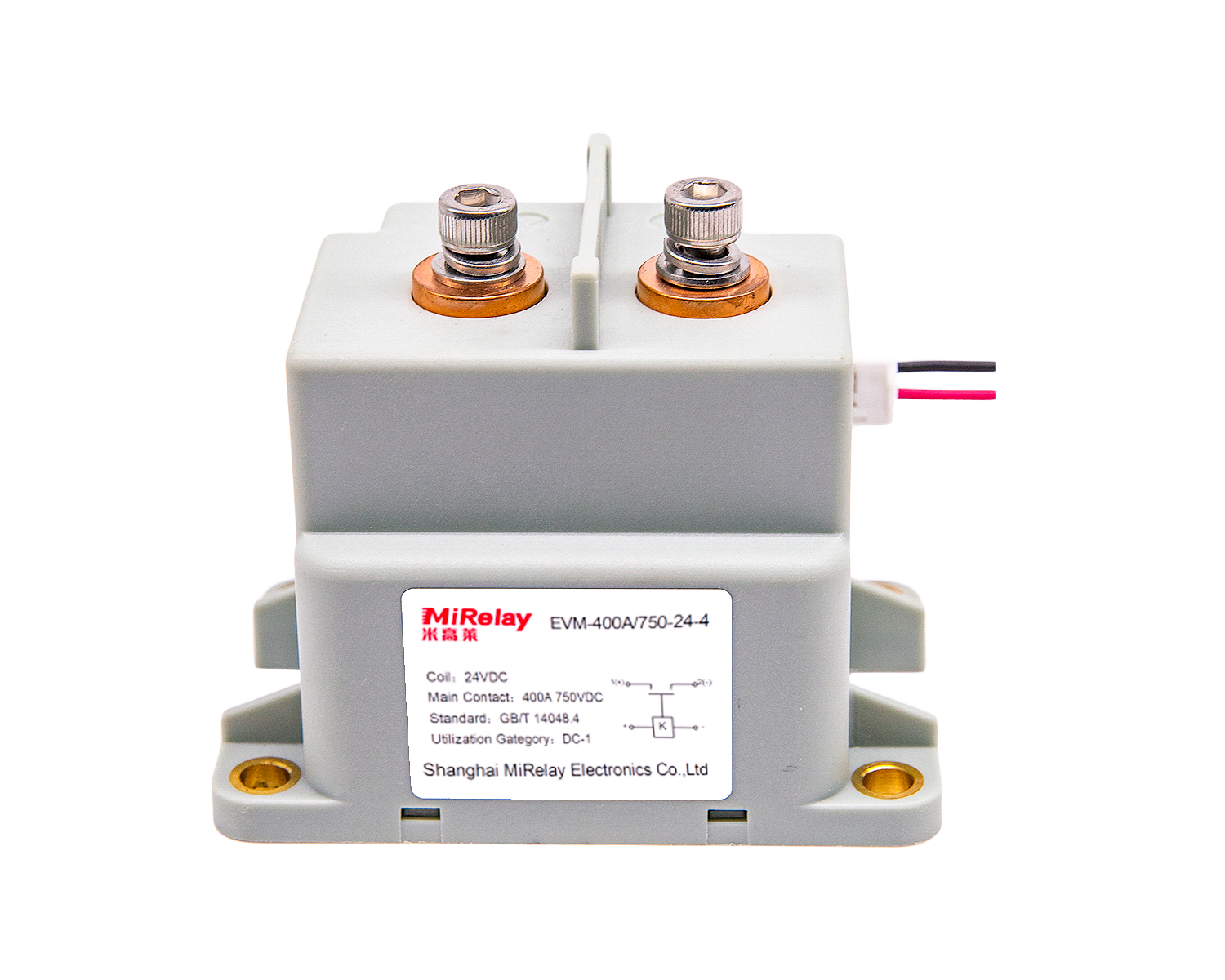
More than 350 GW of PV capacity went online in 2025 alone, and every string inverter in those installations needs a high voltage DC contactor for switching and safe disconnection. The environment inside a solar inverter is hostile in a specific way: heat, daily thermal cycling, and current that flows near-continuously for 8–12 hours a day. The choice between an epoxy-sealed and a ceramic-sealed contactor decides whether the switching layer lasts the full 20-year design life or becomes a warranty line item. Here is how the two options compare in PV service, and where SHR’s EVM ceramic series earns its premium.
What the inverter environment does to a contactor
| Condition | Typical Range | Effect on Components |
|---|---|---|
| Ambient temperature | −40 °C to +55 °C | Material stress, thermal expansion |
| Internal temperature | +65 °C to +95 °C | Accelerated aging, reduced current capacity |
| Daily cycling | 20–40 °C swing | Fatigue, seal degradation |
| Seasonal variation | 60–70 °C annual range | Long-term material breakdown |
Unlike an EV, where the operating environment is at least partly managed, a solar inverter sits in direct sunlight, often in a desert or tropical location, and internal temperatures can sit above 85 °C for hours every day.
Where epoxy sealing runs into limits
Epoxy-sealed contactors, including our own EVI series, are the right choice for many applications. Extreme solar environments expose four specific weaknesses:
- Temperature ceiling: most epoxy formulations degrade above 85–105 °C
- Thermal cycling fatigue: repeated expansion and contraction works the epoxy seal
- UV degradation, in installations where any epoxy surface is exposed
- Outgassing at high temperature, which can contaminate the contact chamber over years
Ceramic-to-metal sealing has decades of history in aerospace and military hardware, and it addresses each of these points directly:
| Property | Epoxy Sealed | Ceramic Sealed |
|---|---|---|
| Max operating temperature | 85–105 °C | 125–150 °C |
| Thermal cycling resistance | Good (thousands of cycles) | Excellent (millions of cycles) |
| Seal integrity over time | Can degrade after 10+ years | Maintained for 20+ years |
| Arc quenching | Good | Superior (ceramic arc chamber) |
| Chemical stability | Can absorb moisture | Hermetic, zero absorption |
| Expected lifetime | 10–15 years | 20–25 years |
Arc suppression in PV service
Solar inverters make unusual demands on the arc chamber. String inverters run 600–1500 V DC, current flows near-constantly during daylight rather than intermittently, cloud passage causes rapid load changes, and safety standards require the contactor to interrupt fault currents reliably.
In a ceramic-sealed contactor the arc chamber is formed from high-purity ceramic (typically Al₂O₃). The walls absorb arc energy faster than epoxy and generate no gas from ablation, so quenching performance stays consistent over millions of operations. The hermetic seal means no gas leakage and no oxygen ingress over 25+ years, so the internal gas composition that does the arc suppression stays as-designed. Ceramic also conducts heat away from the arc zone, which cools the chamber between operations and supports higher duty cycles.
Worked example: 1500V string inverter
| Parameter | Value |
|---|---|
| Inverter power | 250 kW |
| DC voltage | 1500 V nominal (1800 V max) |
| DC current | 200 A continuous |
| Operating temperature | −30 °C to +50 °C ambient, +90 °C internal |
| Expected lifetime | 20 years |
| Safety standards | IEC 62109-1/2, UL 1741 |
Checking the two candidates against these requirements:
EVI-200A (epoxy): 1500 V DC rating passes, 200 A current rating passes, but the 85 °C temperature rating is borderline against a 90 °C internal ambient, and the estimated 12–15 year lifetime falls short of the 20-year target.
EVM-200A (ceramic): 1500 V DC passes, 200 A passes, and the 125 °C temperature rating leaves a 35 °C margin. Expected lifetime is 20–25 years. For this inverter the choice is straightforward.
Cost over the inverter’s life
| Factor | Epoxy (EVI-200A) | Ceramic (EVM-200A) |
|---|---|---|
| Initial cost | Lower | About 15–25% higher |
| Installation cost | Same | Same |
| Replacement (year 12–15) | Labor plus parts | None expected |
| Downtime | Potential revenue loss | Minimal |
| Warranty risk | Higher | Lower |
| 20-year TCO | Higher | Lower |
Over a 20-year inverter lifetime, the ceramic option typically lands 10–15% lower in total cost of ownership, mostly by avoiding the mid-life replacement.
Choosing between the two
Epoxy (EVI series) fits when operating temperature stays below 80 °C, budget is the primary constraint, the design life target is 10–15 years, and the installation is indoors or climate-controlled. Typical cases: residential rooftop inverters under about 50 kW, EV charging stations, and battery storage in controlled environments.
Ceramic (EVM series) fits when internal temperature exceeds 85 °C, the lifetime target is 20+ years, the site is desert or tropical, the inverter is a string or central unit above 100 kW, or reliability is the overriding requirement. Typical cases: utility-scale solar farms, commercial rooftops, hot climates, and any installation where a mid-life service visit is expensive.
EVI and EVM series at a glance
| Model | Current | Voltage | Temp Range | Mounting |
|---|---|---|---|---|
| EVI-50A | 50 A | 900 V | −40 °C to +85 °C | PCB |
| EVI-100A | 100 A | 1000 V | −40 °C to +85 °C | PCB/Busbar |
| EVI-150A | 150 A | 1000 V | −40 °C to +85 °C | Busbar |
| EVI-200A | 200 A | 1500 V | −40 °C to +85 °C | Busbar |
| EVI-300A | 300 A | 1500 V | −40 °C to +85 °C | Busbar |
| Model | Current | Voltage | Temp Range | Mounting |
|---|---|---|---|---|
| EVM-40A | 40 A | 1000 V | −40 °C to +125 °C | PCB |
| EVM-100A | 100 A | 1500 V | −40 °C to +125 °C | Busbar |
| EVM-200A | 200 A | 1500 V | −40 °C to +125 °C | Busbar |
| EVM-300A | 300 A | 1500 V | −40 °C to +125 °C | Busbar |
| EVM-400A | 400 A | 1500 V | −40 °C to +125 °C | Busbar |
Installation notes for solar service
Thermal management. Even ceramic contactors benefit from good thermal design: at least 20 mm spacing between adjacent contactors, thermal paste on busbar connections, forced air above 50 °C ambient, and NTC thermistors near the contactors if you want predictive maintenance data.
Connection quality. Poor connections generate heat, which compounds the thermal stress the contactor is already under. Follow the torque specification exactly (typically 4–6 Nm for M6 terminals), use spring washers to hold tension through thermal cycling, and inspect connections annually.
Protection coordination. Include the pre-charge circuit for the capacitor bank, select fuses that clear before contactor damage, and fit MOVs across the contactor for voltage spikes.
Standards to check
| Standard | Scope | Region |
|---|---|---|
| IEC 62109-1/2 | PV inverter safety | International |
| UL 1741 | Inverters, converters, controllers | North America |
| IEC 60947-4-1 | Contactors and motor starters | International |
| UL 508 | Industrial control equipment | North America |
| IEC 61853 | PV module performance testing | International |
All SHR EVI and EVM contactors carry UL recognition and CE marking. IEC 62109 compliance is evaluated at the complete-inverter level, with the contactor as a component.
What comes next: 2000V systems
The industry is moving beyond 1500 V. String inverters are heading toward 2000 V, and central inverters beyond that. Higher voltage means lower current for the same power, thinner cables, and reduced conduction losses, but also stricter arc suppression requirements. SHR is developing 2000V-rated ceramic contactors for next-generation solar platforms; contact the engineering team for early specifications.
In short: epoxy-sealed EVI contactors are the value choice for residential and controlled-environment inverters with moderate temperature demands, and ceramic-sealed EVM contactors are the right call for utility-scale solar, hot climates, and any system designed for 20+ years of service. The 15–25% premium is recovered through longer service life and the avoided mid-life replacement.
Technical resources
- EVM ceramic series product pages
- EVI epoxy series product pages
- EVI vs EVM comparison guide
- DC contactor selection guide: 400V vs 800V vs 1000V
- Engineering support: [email protected], WhatsApp +86 137 6157 1029
SHR AUTOSENSOR TECH LIMITED manufactures high-reliability switching components for renewable energy, EV, and industrial applications.