Why wide-bandgap test raises the relay specification
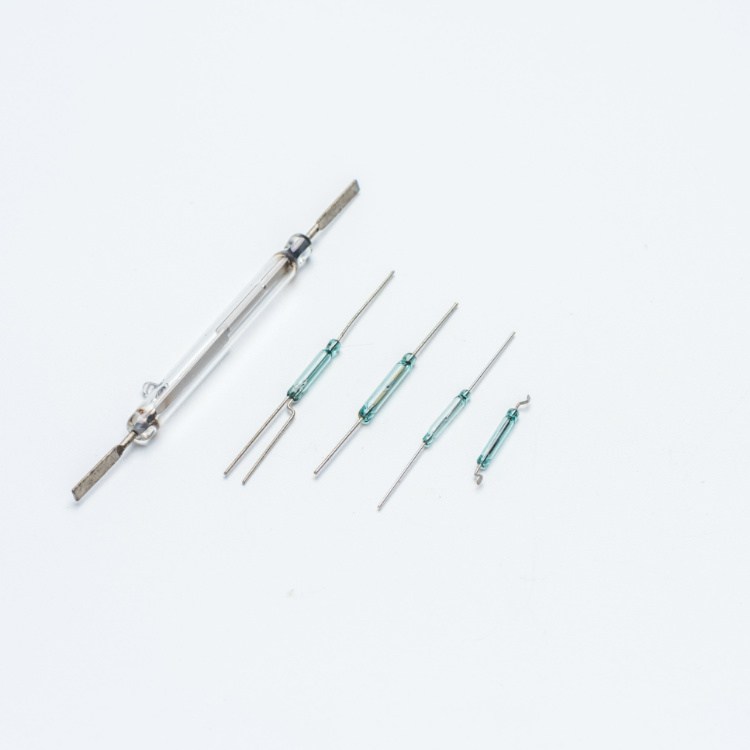
Demand from 5G, EVs, charging, photovoltaics and rail transit is pushing semiconductor reliability requirements upward, and silicon carbide (SiC) and gallium nitride (GaN) devices sit at higher voltage and current than the silicon parts they replace. Testing them applies high voltage and high current at the same time, so the relays in the tester need high switching voltage, high dielectric withstand and tolerance of high-current pulses together. Built on mature reed and mercury-wetted capsules with in-house screening, the relevant series cover the three requirements that follow.
Requirement 1 — insulation resistance
A common semiconductor-test target is leakage below 0.1 nA between high- and low-voltage nodes at 1000 V, which forces relay insulation above 10 TΩ. The HGFR mercury wetted series and the HVFG dry reed series use controlled contact and body processes to hold contact-to-contact and contact-to-coil insulation above that line.
Requirement 2 — dielectric withstand
Dry reed relays reach withstand to 20 kV and mercury wetted relays to 10 kV and above, which leaves margin around the high-voltage stress applied to SiC and GaN parts. Withstand and continuous switching voltage should be read as separate figures — the withstand is a breakdown limit, not the recommended operating point.
Requirement 3 — switching life at line throughput
Packaging and test lines run continuously, so speed and stable contact resistance matter. Reed relays switch within 1.2 ms, supporting several hundred operations per second, and rhodium-plated contacts hold contact resistance stable across hundreds of millions of cycles rather than drifting as a plain contact wears.
Mercury wetted options
- MH (8 kV withstand): high load current, switching to 5 A, low stable contact resistance, insulation 1 TΩ and above.
- HGSR (to 4.5 kVDC withstand): continuous current to 8.5 A and pulse current to 100 A, low contact resistance, insulation 10 TΩ and above.
- HGFR (to 3.5 kVDC withstand): continuous current to 3 A, sealed long-life contacts, insulation 10 TΩ and above.
- HGMR (to 2 kVDC withstand): compact body, continuous current to 3 A, insulation 1 TΩ and above.
Dry reed options
- HVFR: switching to 1 kV (2 kV momentary), 1 A with 5/10/20 A pulses, dielectric 3 kV and above, insulation 10 TΩ and above, switching within 1.2 ms, life above one billion operations.
- HVR: 4/5/6/10/15/20 kV withstand versions, switching to 10 kVDC, 3 A with 5/10/20 A pulses, insulation 10 TΩ and above, in several outline sizes.
Matching the series to the test
SiC/GaN test tends to combine tens-of-kilovolts withstand, tens-of-amperes pulses and sub-nanoamp leakage in one non-stop line, so no single series covers every channel. Use the HVR for the highest-voltage stress paths, HVFR for channels that mix kilovolt switching with pulse current, and the mercury wetted MH/HGSR/HGFR/HGMR where bounce-free contacts or the highest pulse current (HGSR to 100 A) are the deciding factors. Selecting by the binding constraint per channel — withstand, pulse current or leakage — is more reliable than standardizing on one family across the tester.
About SHR AUTOSENSOR
SHR AUTOSENSOR TECH LIMITED (SHR AUTOSENSOR) manufactures high-voltage reed relays, mercury wetted relays and high-voltage DC contactors. Contact: [email protected] | +86 13761571029 | www.reed-relay.com